
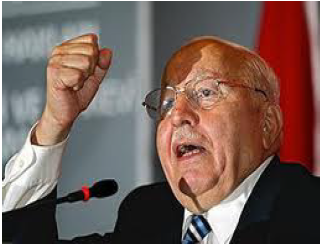
 What else does man need but a
lofty spirit and pure character,
A warm heart, a pure sighted
eye and a restless soul?
(Allama Iqbal)
First they ignore you,
then they laugh at you,
then they fight you,
then you win.
(MK Gandhi)
Journey is often (if not always) a gruesome and tedious task. A person undertakes it to fulfil some objectives, to reach some destination. If we problematise this phenomenon we can conclude that journey is undertaken by a person only if he considers the benefits received at the end of it more worthy than bearing the toils of journey. When suffering is much more than the gains, a journey is abandoned by a rational person. That means if we see a person toiling, braving hardships, sweating miserably, but nevertheless continuing with his journey, we can reach either of the two conclusions; 1. He is insane or, 2. His love for his goal is immense.
Once upon a time, few people dared to tread a path; First one turned back when he saw the uneven and muddy road. Second one retracted when he met a group of people coming down the street warning him of the dangers lying ahead that they had witnessed themselves before returning back.
Third one progressed until he was offered some sweets by a ‘well-wisher’ for not treading the dangerous path. Fourth one retraced his steps when he was intimidated of the grave consequences by an army regiment on the way. The fifth one cake-walked across the muddy road, as if uncaring of the dirt and its impact on his white starched suit. He was so confident of the path undertaken that he didn’t pay heed to people warning him of the dangers lying ahead. Goal was dearer to him. And it was worth bearing hardships and taking risks. He not only stepped forward himself but also took many of those fellows that were earlier scaring him of the dangers. Such was the power of his conviction. Sweets were gently refused by him & his followers with a polite smile and they continued their journey. Then the sign of ‘STOP’ appeared but they jumped over the barricade. Later on the route some police constables tried to frighten them away but they didn’t succeed. At last an army regiment halted their way forcefully and stopped the caravan. The caravan was dejected. But the leader, who took the initiative of walking on this path, addressed them eloquently; “our loyalty is not with this road of concrete and cement but with the destination; there can be many routes to a single destination. We have no problem in changing tracks if only the chosen track leads to the same destination. Come friends we will take another
path”. “But there is no alternative path” contested one of his followers. “We will make one” declared the leader with a tight fist and broad smile. On hearing this statement an electric current of determination ran through the body of all his followers who chanted slogans of takbir with fists flying in the air in unison. Arbakan was a traveller of the fifth kind. He kept his eyes glued to the goal and kept changing tracks as far as those tracks actually led to the goal. He was criticised, threatened, arrested, assaulted, but he continued with a smile on the lips, and an undaunted determination in the heart. He was true to Maulana Maududi’s conception of a Muslim. “A Muslim” argues Maulana Maududi “has not been born to swim with the tide. The very objective of his life is to make the
river of life flow on the course which is right, which is straight. If the river has changed its course – then the person is liar in his proclamation of iman who acquiesce to swim on this altered course. The one who is truly a Muslim will fight with the velocity of the river; will enervate him in the endeavour to alter its route. He will not care for success or failure. In the process he will bear every loss – amiably. Even if his arms are fractured and muscles cracked fighting with the ferocious waves and tides throw him away – half dead – on shores; then also his spirit will not be defeated”.
Historical Role:
Let’s analyse what is the historical role that Arbakan played in Turkish society and in the world at large. For that we will have to analyse the environment of Turkey and condition of Islam therein, at the time when Arbakan took the mantle of leading the Islamic movement. Shujatullah Husaini emphasise on this contextual approach of looking at Arbakan when he says: “Look, in what environment he took up the task of leading the movement for Islamic revival in Turkey. In 1950 Turkish president Adnan Mendres was hanged. What was his crime? He was not an Islamist, though he did not cherish the hatred of Islam as his predecessors. His crime was only to build a mosque near the mausoleum of Mustafa Kemal Ataturk. Just six years later, in an environment where building a mosque could lead to the capital punishment; Arbakan, a youth of 32 years daringly took up the cause of Islam. In such a hostile environment Arbakan not only uttered the name of Islam but confidently and unhesitatingly launched a whole movement for the revival of Islam. Truly No one can estimate the greatness of valour and will power of Arbakan”.
Born in 1926 Necmettin Erbakan (read: Najmuddin Arbakan) witnessed the catastrophic effects of Ataturk’s secularism and ultra-modernisation on Turkish society. Caliphate was abolished just two years before he was born. Hat law introduced western style hats; fez caps and turbans were banned (1925). Through further legislation of ‘prohibited garments’, wearing religion-based clothes for e.g. headscarves and veil became a criminal offence (1934). Madaris were closed and Dervish lodges i.e. religious NGOs were abolished (1925). Sharia law was done away with and instead Italian penal code and Swiss civil code was adopted (1926), principle of laïcité (i.e. complete separation of religion and state) was included in constitution (1937), Education was unified i.e. only state recognised educational institutions were allowed to teach, no private education was tolerated (1924), Turkish script was changed from Arabic to Roman (1928), Turkish Historical Society was established to reinterpret Turkish history (1932) and Turkish Education Association was formed to change the orientation of education (1928). Restrictions even on Adhan and Salat were imposed.
In such an environment Islamic political activism was impossible. A spiritual awakening and character building was called for. It is through this spiritual awakening and strengthening of character that platform for later political activism was to be built. 13 years of such rigorous training in discipline and character-building in Makkah is the foundation without which political activism of Madinah could not be sustained. This spiritual phase of the Islamic movement in Turkey of 20th century ridden with Kemalism was fulfilled by Bediüzzaman Said Nursi. His tacit movement based on Risala e Nur (letters of light) send shockwaves throughout the Turkey and enlightened the hearts especially of youths for not less than four decades. The situation was much changed when Adnan Mendres became the president with the active support of students of Risala e Nur. Turkey was still not a fertile ground for Islam but the basic task that
Bediüzzaman assumed for himself i.e. of making Islam less abominable to the common Turk was ulfilled. In 1960 Nursi died. Now the time was ripe for ‘political activism phase’ of Islamic movement. But who will lead the movement on this thorny track? And here comes Arbakan into the picture. To put my point bluntly let me argue that if Arbakan would have been born in place of Nursi he would had to take on the course that Nursi took, as political activism then would not have meant bravery… but suicide! It was like playing the stroke before the ball reaches to the bat and thereby leaving the stumps bare only to be bowled out.
So when Arbakan realised that an environment has been created by Risala e Nur movement and people are now having a soft corner for Islam but they only fear repression of state and only political initiative is needed to organise and politicise the discontent of the masses that he took up the task. Nursi played the role of first awakening and enlightened the Turkish hearts from within while Arbakan’s contribution lies in reflecting this light and illuminating the ambience. Before applying the Turkish model to any other country what we explained above is important. Movement of Arbakan cannot be viewed and analysed (much less to be applied) in isolation. It forms a whole with Nursi movement though one can never find an iota of institutional connection between the two movements.
4Ps:
We can epitomise Arbakan in 4Ps i.e. Patience, Perseverance, Persistence and Progress. He avoided unnecessary confrontation with the authorities and like a forceful stream gushed forth on the decided route but never hesitated to move diagonally to avoid an obstinate rock. Milli Gorush Movement, National Order Party (1970-71), National Salvation Party (1972-81), Welfare Party (1987-98), Felicity Party (2003-11). Paths (rather names) were different but goal was one – establishing the rule of Allah on His earth. What should be kept in mind however is the fact that, Arbakan changed tracks not directions. When fed up with defeats and bans on Islamic parties formed by Arbakan, many of his followers urged him to ‘accept the reality’ of the Turkish society i.e. they advocated blatant acceptance of secularism, ties with US, joining EU etc. Arbakan refused even at the cost of division of Milli Gorush Movement. Thus AKP was formed by dissenting followers of Arbakan. Not success and failure but hard work in the right direction was important for him and it is enough for the salvation. Once Arbakan said to Mustafa Tahan, “If God asked me on the Day of Resurrection, what have you done for Islam? I will offer him these five
parties”.
One cannot and should not doubt the intentions of Erdogan and other colleagues of AKP. But the lesson taught by the Hoca (pronounced as hoja meaning Teacher) Arbakan is that: ends are not important enough to compromise with the means. Islam provides one with ample opportunity to imply one’s wisdom in any field and same is true for political activism but the compromising path that AKP adopted was too much for Arbakan. ‘Martyrdom is as big an achievement as victory’: this Islamic dictum was his motto. Political victory attained after shedding Islam and compromising with principles is a loss of both worlds. As Iqbal has said, If Muslim bargains freedom for religion In such a trade the loser is Muslim!
Then why Erdogan and his regime appear so successful in term of its Israel bashing foreign policy and economic developments etc? Two points should be kept in mind while dealing with this question:
1. Arbakan was prime minister only for one year, that too in a coalition government while Erdogan is prime minister now since eight years. If Arbakan would have got the respite, the history would have been different. Even his small tenures (both as prime minister and deputy prime minister) are full of foundational achievements.
2. If Erdogan and AKP are tolerated by military, the credit for this goes more to Arbakan and his Sadat Party than policies of AKP. Military and people opted for ‘lesser evil’ i.e. AKP instead of full fledge Islam in terms of Sadat Party. If alternative of Sadat Party would not have been there, military would not have tolerated even AKP.
But these are mere hypotheses; a proper research instead of mere speculations is need of the hour on the Turkish model of political activism and especially its relevance for other countries. We are not here to draw conclusions what I presented above is the dimension that seems to be missing from popular analysis.
Achievements & Legacy:
A mechanical engineer by profession Arbakan undertook the task of not repairing the motors and machines but embarked upon repairing the damaged psyche, self confidence of the people on the one hand and dilapidated political structure of Turkey on the other. One of the major achievements of Arbakan was the political language that he evolved and successfully used in a diverse and plural society, in a society where authorities were overtly hostile to Islam. His speeches, writings, policies, manifestos, constitutions were always composed in a ‘legally-correct’ language, though everyone from authorities to the masses knew the meanings and connotations of his words like national view, self-reliance, cultural emancipation etc.
He was a visionary. His vision of economic and thereby cultural independence from the west, vision of an Islamic block D-8 etc were thoughts far ahead of his times. His contributions to the economy of Turkey like industrialisation, reduction of inflation and foreign debt, creation of employment opportunities etc would always be remembered. And this was precisely the reason that even not-so-Islamic people were also fond of Arbakan and voted extensively for him. His political and economic contributions and strategies has been extensively analysed in the next pages.
His will was unconquered. Doctors said Arbakan died of heart failure. He was also suffering from respiratory problems and a chronic vein infection in his left leg. In his last days he looked increasing frail and used a wheelchair. But he lost nothing from his passion and zeal and held meetings with party associates even in hospital.
Recep Tayyip Erdogan, Abdullah Gul and Ahmet Davutoglu and others under whom Turkey is putting up a brave face in international affairs are all lieutenants & students of Hoca Arbakan.
Arbakan – the hero of Islam – died on 27 February 2011. But he did not die. He is alive and will remain alive forever – not only in our thoughts but also in actions. Death approaches him who is mere a man, who is not a thought, not an ideology, not a revolution, not an ideal. Thought and ideology could not die, cry for revolution could not go in vain. And Arbakan was the cry for revolution; he was a movement himself. How could he die? The fact is only that a restless soul is finally resting!
In short ‘Arbakan’ was not a person ‘Arbakan’ is a phenomenon which means that Limits exist only in the mind and despite the odds, despite the obstacles, despite the injuries, despite the enervation – The Journey Is Possible. It’s our will that counts and nothing else matters!!!

0 Comments