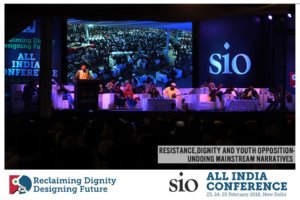
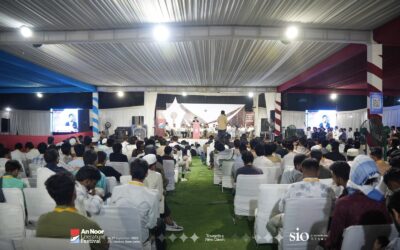
Students belonging to different political organizations across universities shared their views, aspirations and hopes making it a mind-blowing session before a curious audience.
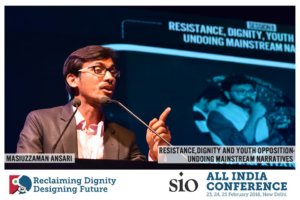
Masihuzzama Ansari (Ex-National Secretary,SIO)
Mr Ansari started delving into the regions diversity of nation challenged. He opined that the gathering will tell them love is greater than hatred. A dawn of fear is arising, when academic debates stay away without discussing fundamental problems. We the People in the constitution doesn’t mean some, but it means hamm andaap. There is no need to be in a panic, when the struggle and rule of the law are still active and on the long way to go. A better morning will be made possible by SIO.
Government supposed to give the people security moves away from this once they are elected, Najeeb and Junaid are examples of the same. Nationalistic politic arising is making the people afraid of religious symbols like Tika and Toppi He also quoted words from Surah Hujjooraat to suggest that Islam promotes brotherhood in a unique manner. The ruling party comes up Beta Pad, which is not enough to mow away obstacles. He also wondered that why good human being is not coming out graduated from Central Universities and other leading organizations. SIO is motivating us to come with a better confidence to make a better future possible.
T P Ashrafali (National President, MSF)
Ashrafi from Muslim Students Federation (MSF) opined that the present time is the right moment to sit and congratulated SIO for prompting an exchange of talk. “The nation is asking the youth that why are you asleep”, he illustrated the need of awakening of youth is important. Recalling the first and second struggle of Indolence in !857 and later, Ashrafali argued that it is time for freedom struggle from the saffronised ruling party. The recent developments in the central universities and student movements associated with are questioning the mainstream political parties avoided ‘untouchables’. Right-wing politicians are asking Muslims to leave for Pakistan. 2019 should be the real deadline for the ruling party and mainstream political parties should open their eyes to carry the developments forward. 5 students are denied M.Phil. entrance hall ticket only because they resisted the secessionist interests. Despite demands from different quarters of concerns and powers, authorities have remained as it is with staunch casteist views. Although the speakers of the sessions are from the different organization, Ashrafali was all hopeful that SIO conference will strengthen the effort and congratulated SIO for it continuous efforts against fascist forces.
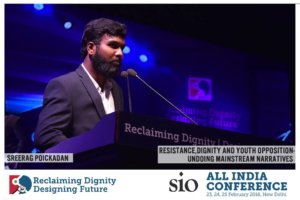
Sreerag Poickodan (President, HCUSU)
Sreerag Poickodan from Hyderabad Central University began his words recalling his place of origin to the political developments that lead to the institutional murder of Rohit Vemula. Vemula’s accusation was that it is merely identities that are marked in Indian elite academic space, not distinct minds. HCU is the only university where Muslims and Dalits come together, remarked Sreerag on his university. If Dalit and Muslim unity comes into effect, no one can challenge them from forming a strong power, highlighted Poickodan. The same made it possible for AISA to win the President post in HCU Student’s union, hopefully resulting in the fruits of actualization of Dalit-Muslim politics. This should also develop to an “organic” reality. Underlining the weaker points of Dalit unity, Poickodan opined that a sense of community is the point where SIO is advanced, while Dalit community remains “outcaste” from Hinduism. Poickodan recalled Ambedkar’s call to leave the religion and renouncing his exit from Hinduism, joining Buddhism. It is time for Muslim organization and ASA should have a dialogue on coming together for mutual interests. Continuous episodes of protests are producing a bad feeling in us, we should strengthen tenets to actualize Dalit-Muslim politics we dreamt for.
MASHKOOR AHMAD USMANI (ALIGARH MUSLIM UNIVERSITY)
He said that the real opposition to the government is in universities and campuses, not in parliament. Drawing the emphasis of the Quran on being educated he observed that Dalits and Muslims are the most illiterate communities of our country. There should be effective attempts to make education accessible to these communities. The Indian government has been a failure in providing employment opportunities that Indian youth seeks the most.
ANSAR ABOOBACKER (NATIONAL PRESIDENT, FRATERNITY MOVEMENT)
Ansar Aboobacker began his speech citing the incident of the death of Faiz, a Muslim youth from Kerala, who was alleged to be a terrorist by police. From the mother of Faiz to mothers of Najeeb and Rohit, there has been a drastic change in their conception of narratives of state and police, and in their reaction to the atrocities meted out to them. The time when mainstream narratives where accepted with no objection has passed. We are witnessing mothers who question the police narratives and raise their voice against the oppressors. Organizations like SIO have played a great role in bringing this change, constantly challenging the state-police narratives. ‘We will not keep mum and accept the police narratives. We will continue raising questions until it gets answered’. Though more than hundred seats in parliament are reserved for marginalized communities their representation is near to nothing. There has been no space for the questions of Fathima Nafees and Radica Vemula in our democracy. Questions surrounding Afzal Guru’s hanging has no space in our democracy. Congress stayed Muslims away from the party in Gujrat during the election in the name of ‘strategy’. This is the state of our democracy. Amidst all these rays of hope are there in the country. New movements like that of Jignesh Mevani are giving us great hope. What we witness in the country is the battle of politics of fraternity Vs politics of hate. Ending the speech, he shared his hope that a new kind of politics from the youth of India arise in 2019 election.
HEBA AHMAD (YFDA, JNU)
Heba Ahmad began her speech talking about Najeeb and Hadiya. Percentage of Muslims in higher education is less than two. Though we have been discriminated in the educational spaces, we too have roles for this pathetic state of the community. We must encourage and help our youth, and girls to get an education. Muslim students feel a lack of belongingness in campuses. SIO has been working on it constantly stating there is no need to be apologetic in being Muslim. She concluded saying that we should identify ourselves as fighters, not mere victims.
FAIROZE KHAN (PRESIDENT, NSUI)
Fairoze khan spoke about the increasing poverty and unemployment in the country. He urged that students and youth of the community should come forward to the mainstream.
AZIZUR RAHMAN (PRESIDENT AAMSU)
He laid the history of Assam Muslims and their contribution to the society. Assam Muslims has been demonized and dubbed as Bangladeshis, he said.
NADEEN KHAN (UNITED AGAINST HATE)
Nadeem Khan observed that RSS has been creating fear in the campuses to prevent Muslims from getting educated in prestigious institutions. If they could make one Najeeb forcefully disappear, thousand Najeeb will join the campuses, failing the hate campaign perpetuated by RSS and ABVP, he opined.
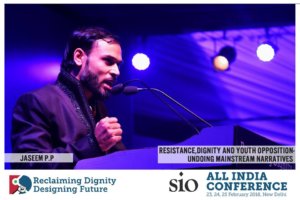
JASEEM TIRUR (NATIONAL SECRETARY, SIO)
‘Roots of the oppression meted out to Muslims lies in the fact that we are deprived of power. Taking energy from the spirit of Islam we should seize power from those who hold it now’, he said. If we hold onto the Eeman, Allah will show us a path out of the dilemma we are in today. He also opined that it is happy to see slogans about Maudie raised in campuses when demonization campaign against him is in full swing.
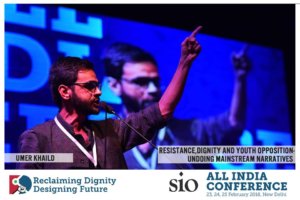
UMAR KHALID (BASO, JNU)
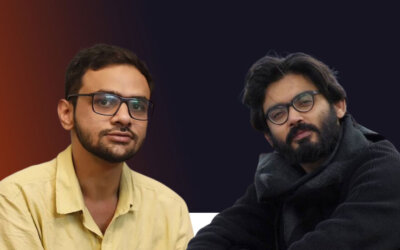
Umar Khalid stated that discourse about unity is not about uniformity. The notion of one nation, one language and one culture are the agenda of RSS and BJP. Corruption and nepotism in the appointment of professors are rampant in the universities. BJP is vouching to put an end to student politics if this is their policy they should stop ABVP in the first place. It is clear from it that problem of BJP is not with student politics but with student politics that asks questions to them. He criticized the government for their wrong educational policies. He also observed that BJP has been leading the campaign to distort the history of Muslim rulers of the country and creating riots for political gains and to avert the attention from real issues.
PM SALIH (PRESIDENT, SOLIDARITY YOUTH MOVEMENT)
The president of Solidarity Youth Movement began his words delving deep to post-truth conditions where lies are spreading fast across media platforms. A post-truth society is highly depoliticized, and the individuals are reduced from the collective sense of society. Global Ithihad is struggling against Imperial-Zionist-Sanghparivar ally. The hatred spread by latter is producing repercussions as we seen in Myanmar, widely moving to other parts of the world. Modi’s reign after 2014 saw question posing individuals and intellectuals like Gauri Lankesh suppressed and murdered. Salih recalled the initial troubles Jamat-e-Islami had to face in the times of its establishment. The youth of the present should prepare themselves to face politics. If the Oxford Dictionary saw the ‘Post-truth’ word entering in 2017, this year we are seeing ‘Youthquake’ making its entry into wide coinage. Islam has established on tenets of mutual love and brotherhood, powerful to challenge Zionism and similar currents founded on racist spirits reducing the dignity of humanity. He cited Sideek (RA), Bilal (RA) as the best examples we can find in Islamic history as inspiring models of brotherhood. February we are passing through is also the instance when martyr hood of Hasanul Banna, Sayyid Qutub Malcolm X and Shaheed Azmi, remembered him inspiring the gathering of youth.
RAHUL SONPIMPLE (BAPSA, JNU)
He criticized that beyond making a joke out of Modi and BJP the so-called secular/liberal/Lefts have failed in giving a counter-narrative.He further criticized the shallowness of the anti-fascist rhetoric of the secular-liberal forces. It is important to keep frivolous discourses and jokes aside and to speak about real issues and form a strong counter-narrative. He opined that such a politics and narrative could not be formed in collaboration with either Congress nor so-called secular-liberal-Left organization. It is only possible through the alliance of Dalit-Muslim-Adivasis of the country. Political agency of ours should not be let taken away. ‘If the pain and struggle are ours, leaders should be ours too’.
FASNA MIAN (PRESIDENT, GIO)
The theme of the conference gives confidence and hope when different kinds of suppressions and washing off identities have become the norm of politics. All those who having self-confidence with strong discourse can challenge the same. Islam teaches us to strike against us violence. Quran calls upon the believers to strike against us violence. A progressive state like Kerala, even saw Hadiya haunted by traumas for choosing Islam and Wayanampadi wall issue where Dalits are targeted. When Bilal (RA) got paralyzed by slavery, Islam honoured him with dignity.
The social life of girl will not improve with a selfie of PM with a random child from the crowd. Triple Talan, Hijab is rooted from Islamophobic sentiments. We should walk outward with no fear. Society should be strengthened to rise into future with better hope.
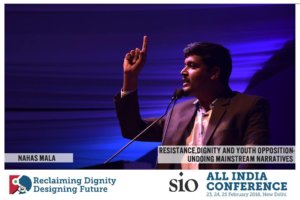
NAHAS MALA concluded the session thanking all the dignitaries for attending the session and enlightening the audience with dynamic views.
MEHDI HASSAN AINI QASMI (PRESIDENT, AMI DEOBAND) and
MATEEN ASHRAF (CABINET MINISTER, AMUSU) delivered speeches addressing the conference.
0 Comments