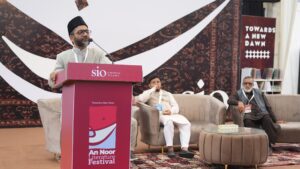
Designed as an intellectually stimulating platform for exchange, critical thinking, and social reflection, the festival celebrated Islamic heritage, philosophy, literature, art, and civilizational contributions. Across three parallel stages, the event hosted a rich series of lectures, workshops, panel discussions, cultural events, and artistic exhibitions.
The festival officially opened with a keynote address by Syed Sadatullah Hussaini, President of Jamaat-e-Islami Hind (JIH), on the topic ‘Towards a Grammar of Liberation: Thinking Islam in the Postmodern Condition.’ Advocate Anees Rahman, SIO National General Secretary, welcomed the gathering and articulated the core intent behind organizing the second edition, highlighting the overwhelming support of the SIO cadre nationwide.
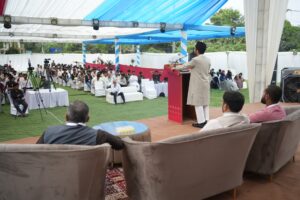
The festival featured a diverse line-up of speakers including Member of Parliament Mohibbulah Nadvi, Prof. Nivedita Menon, Prof. Shafey Kidwai, Prof. Amitabh Kundu, Dr. Amirullah Khan, Dr. Ghazala Jameel, Journalist Kunal Purohit, Filmmaker Nakul Sawhney and more. The two-day event saw participation from a vibrant set of audience members and professionals alike, including authors, politicians, academicians, scholars, journalists, artists, filmmakers, public intellectuals, and members of civil society.
In a critical session titled “When the Last Line of Defence is Challenged: The Future of Waqf, Madarsa and Masjid,” prominent political figures and community leaders gathered to address structural challenges and policy threats facing key Islamic institutions in India. Moderated by Talha Mannan, the panel featured Mohibbullah Nadvi (M.P.), Malik Moatasim Khan, and Dr. S.Q.R. Ilyas.
Marking two decades since the Sachar Committee Report (2006), panelists Prof. Amitabh Kundu, Dr. Abu Saleh Sharif, and Mr. Amirullah Khan (moderated by Dr. Kashif Mansoor) analyzed its legacy, ongoing marginalization, and regional disparities. Mr. Amirullah Khan highlighted how national narratives have given way to stark regional issues, while Prof. Kundu stressed data-driven evidence over advocacy in measuring structural discrimination.
In a provocative discussion titled “Whose Knowledge Counts as Indian? Education, Curriculum and the Reconfiguration of Power,” Prof. Nivedita Menon (in conversation with Fawaz Shaheen) critically examined educational policy, secularism, and decolonization: “The language that we already possess is democracy,” noted Prof. Menon, cautioning against uncritical acceptance of official knowledge claims. Pointing out the continuous nature of resistance and debate, she remarked: “This is not a full stop; this is a comma.”
Independent journalist and author Kunal Purohit discussed how hate-driven music and pop culture are deployed to incite hostility and communal polarization. He highlighted how digital platforms monetize hate speech and noted the urgent need to address culturally shaped political violence to restore multi-cultural coexistence.
In the panel “Reading Dr. Abdul Haq Ansari: On Sufism and Shariah” (moderated by Farhan Saifi), Dr. Khan Yasir and Dr. Muhammad Mushtaq Tajarwi explored the harmony between spiritual discipline (Tasawwuf) and Islamic jurisprudence (Shariah). Furthermore, scholar Dr. Hasan Raza delivered a key address on Islamic Aesthetics, Literature & Postmodernism.
In the panel titled “Within and Against: Muslim Women, Agency and the Structures of Power,” Dr. Ambreen Agha and Shayma S. (moderated by Yusra Hasan) challenged simple binaries of oppression vs. freedom, emphasizing how Muslim women exercise complex ethical and social agency across diverse spheres. Another session, featuring panelists Muhammad Sajid, Zarine Khan, and Supriya Joshi (moderated by Dr. Roshan Mohiddin), advocated for flexible, experiential learning models centered on empathy, curiosity, and individual needs rather than rigid, exam-driven frameworks.
Additional discussions addressed topics covering civil liberties, technology and AI, media representation, environmental philosophy, alternative education, and public knowledge systems.
The festival featured three interactive workshops designed to cultivate practical skills and facilitate deep intellectual engagement across film, political theory, and philosophy. Adnan Safee conducted a hands-on workshop on Film and Screenwriting, while Dr. Irfanullah Farooqui led a session titled Thinking Through Azad: On State, Nation and Religion. Additionally, Dr. Huzaifa Omair Siddiqui facilitated a workshop titled Thinking With Allama Iqbal: On Philosophy, Power & Politics, exploring Iqbalian thoughts in contemporary discourse, while Dr. Sumaira Nawas, in her session “Masjid Se Maikhana Tak: Religion, Satire & Literary Modernity,” highlighted the role of self-reflexive humor in Muslim intellectual history.
Beyond academic dialogues, the festival featured vibrant artistic and cultural showcases that resonated deeply with the audience.
A curated exhibition, dedicated to Palestinian academic, poet, writer, and activist from Gaza, Dr. Refaat Alareer, highlighted Islamic civilizational history, art, calligraphy, and literary milestones, reflecting solidarity for political prisoners across the globe through artistic expressions, serving as a visual reflection of the festival’s theme ‘Towards a New Dawn.’
Furthermore, a recitation of Allama Iqbal’s poetry by Khurram Murad and team, a Dastan (storytelling) performance on Sultan Salahuddin Ayyubi by Syed Sahil Agha, and a South Indian Duff Muttu folk art performance were performed across stages by young artists.
An engaging ‘Mushaira’ session brought together prominent and emerging Urdu poets who performed their poetic verses on the themes of social justice, hope, identity, and liberation.
The two-day event was concluded with a soulful musical performance by Dr. Haider Saif, which captivated the audience, blending spiritual rhythm and poetic themes, binding the audience under the ‘Melodies of Dawn’.
The festival concluded with remarks from Curator Saiful Islam, an address by SIO National President Abdul Hafeez, a presidential address by Syed Sadatullah Hussaini, and a vote of thanks by Festival Convenor Dr. Roshan Mohiddin. The event marked a landmark milestone in reviving critical thinking, social cohesion, and democratic exchange.
The successful execution of the An Noor Literature Festival 2026 marks a historic milestone for SIO India. By creating an inclusive space for critical discourse, intellectual resistance, and artistic revival, the festival demonstrated that literature and cultural heritage remain vital tools for fostering mutual understanding, justice, and democratic dialogue in contemporary society.
0 Comments